
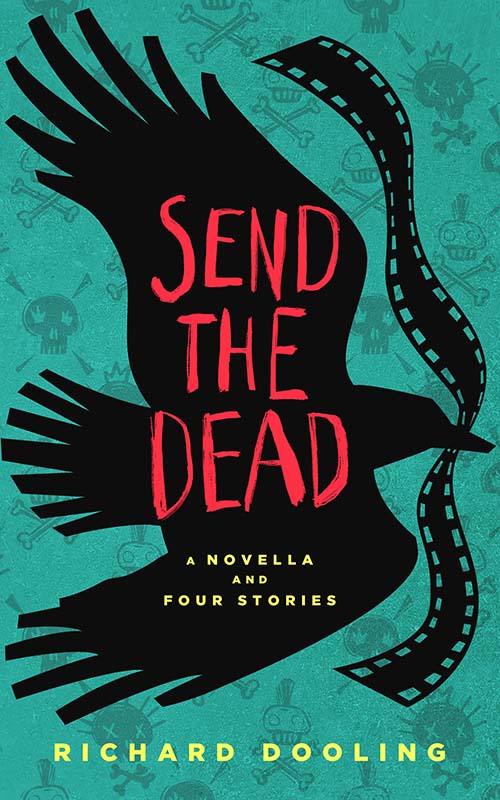
Send the Dead
She Can’t Call the Police, so She Summons the Dead.
Marina January makes a living guiding tourists through the haunted ruins of St. John’s sugar plantations — undocumented, paid under the table, collecting tips to fund an immigration lawyer while staying one step ahead of ICE.
When a famous director recruits her as a consultant for his new historical film, it feels like a lifeline — especially when the film’s magnetic star, Gabriel Nash, takes an interest in her. Nash is as dangerous as he is charming. His obsessions nearly destroy her, until she fights back, using her knowledge of Caribbean history, its lore, and the malevolence of the occult. Nash badly misjudges her instinct for survival.
New York Times bestselling author Richard Dooling brings together the title novella and four eerie tales — first published in The New Yorker, Story, Smoke, and Esquire — in a collection spanning literary horror, Hollywood glamour, Caribbean history, and supernatural vengeance.
The Four Short Stories
The novella, Send The Dead, comes with four of my favorite short stories.
Bush Pigs
Originally published in the New Yorker, this harrowing tale is a cult favorite among expats who wander abroad and are unprepared for the shock that awaits them upon return to the States. After three years in the bush, a Peace Corps Volunteer is evacuated from war-torn Sierra Leone and sent home to Omaha, Nebraska, where he attempts to celebrate his return in a steak house. What happens next is called reverse culture shock. G.K. Chesterton put it this way: “The whole object of traveling abroad is not to set foot on foreign land; it is to set foot on one’s own country as a foreign land when one returns.”
How Bush Pigs Came To Be
Parts of my second novel, White Man’s Grave, are set in a village in Sierra Leone, where a Peace Corps Volunteer has gone missing under suspicious circumstances. Many readers come away from it thinking that I was a Peace Corps Volunteer. I was not, but a good friend from college, Mike O’Neill, was, and I stayed with him for months in the remote village of Mbundobu.
Among many other talents, Mike has a gift for languages. He spoke several tribal languages, especially Mende, and took me all over Sierra Leone on the back of his Peace-Corps-issued Honda motorbike. We shared many adventures, some of which are in White Man’s Grave.
About ten years after my visit and just before White Man’s Grave was published, Mike actually did go missing in Sierra Leone, where he led the Red Cross relief operation. Mike was captured by rebel teenage warriors in the east of Sierra Leone. He was held for thirty days, during which time the village he was in was bombed. He eventually walked 47 miles through the bush, No Man’s Land, between the rebels and the government troops and was reunited with his family and returned to Buffalo, New York, where he had grown up before I met him. I spoke to Mike by phone soon after his safe return and heard his incredible story. That night and the next day, I wrote the first part of Bush Pigs. The second part, set in a steakhouse in Omaha, was an out-take from an early draft of White Man’s Grave.
Performances of Bush Pigs
Bush Pigs was published in The New Yorker in 1994. National Public Radio played an audio version of the story a few times, and I received well-wishes from many expats and returned Peace Corps volunteers (RPCVs) who heard it. A few years later, Symphony Space in New York City asked actor Mark Nelson to read Bush Pigs live at its Selected Shorts program. The performance also included a reading of Jumpha Lahiri’s Hell-Heaven.
I have permission to share the Selected Shorts audio version with you, but please do not download or distribute it, as I do not own the rights to the recording, just the underlying story.
Mark Nelson reads Bush Pigs at Symphony Space
Mapping God’s Voice
The venerable Story magazine has been around since 1931 and published Truman Capote, Joyce Carol Oates, Carol Shields, and many others along the way. In the 1990s, Story was edited by the beloved Lois Rosenthal, under whose direction the magazine was five-time finalist and two-time winner of the National Magazine Award for fiction.
Lois was a fan of my third novel, Brain Storm ) which was, in part, about forensic neuroscience and scanning criminals to detect abnormalities that may have caused them to malfunction. Lois called once with a question about temporal lobe epilepsy. It may have been a ruse, because when I mentioned that Dostoyevsky suffered from temporal lobe epilepsy, and that he had once said that he would trade ten years of his life for a single aura, the often mystical sensation that precedes a seizure, Lois said, “I want you to write a story about that for me.”
So I did. But more than neuroscience, “Mapping God’s Voice” probably came from working nights on a psych ward in my early twenties to pay off my college loans. I took the job because, if the patients slept, I could read and write all night. But at least once a week, my literary labors were interrupted by a distressed patient who needed my help, because God was talking to them, speaking in plain English, about glory and eternity. The doctors were saying, take this pill and you’ll stop hearing God’s voice, but why in God’s name would I want to stop hearing God’s voice?
Paleopsychosis
I wish I could say something noble or uplifting about this story, but it amounts to the literary equivalent of a drinking song for evolutionary psychologists and paleoanthropologists. Peking Man and Piltdown Man chase the Venus of Willendorf around a prehistoric tavern called Stone Binge. I still like it, or it would not be in this collection, but it could be charitably described as sophomoric.
It originally appeared in Smoke magazine, a men’s cigar-themed magazine.
Diary of An Immoral Man
Back near the turn of the century, longevity was much in the news and on the minds of researchers, who were looking into extending human life spans to 150 years and beyond. In 1999, Esquire magazine called with a proposal: Would I write the diary of the first man who lives forever? Would I pretend to be the first person who escapes the grave by taking anti-aging drugs and regenerative medical treatments? If I get cancer of the liver, they explained, I don’t die, I get a new liver transplanted in me that was grown from my own stem cells. And then what happens?
This piece was a finalist for the National Magazine Award. I call it a speculative essay, but it could pass for a short story.